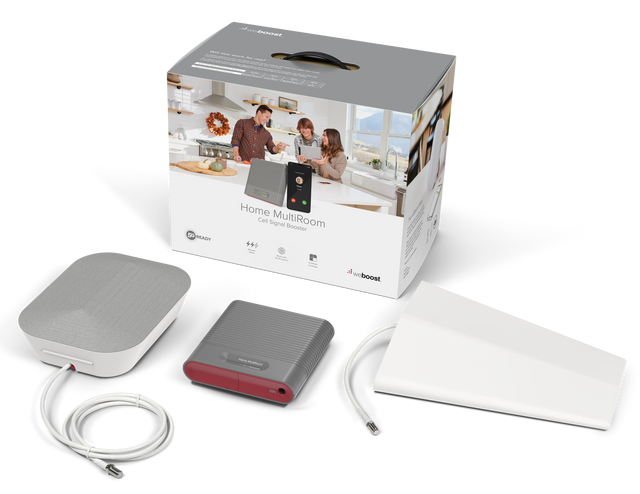
weBoost 470144 Home MultiRoom Signal Booster
Your Order Includes:
- 90-Day Returns
- Lifetime Tech Support
- 2-Year Warranty
- Lowest Price Guarantee
Outside Antennas
The right outside antenna comes down to three things: how strong your signal is outside the building, the terrain around you, and which direction your cell towers are in. The stronger the antenna, the more signal your amplifier has to work with, and the more coverage you get inside.

- Omni Antenna: Receives signal from every direction with 4 dB of gain, and there's nothing to aim. Choose it when your outside signal is strong enough that you don't need extra gain, or when you're in a valley or hilly area where the signal bounces around a lot. Its wider, lower-gain pattern handles bouncing signal better than any other option here.
- High Gain Omni Antenna: Receives from every direction like the standard Omni, with up to 9 dB of gain instead of 4. This is the right choice for most buildings. You get close to the Yagi's power without having to aim anything, and it works when your carriers' towers sit in different directions.
- Yagi Antenna: A directional antenna with 10 dB of gain. Choose it when your signal is weak and comes mostly from one direction. You aim it at the tower, and its 75 degree view of the horizon means the aim doesn't have to be perfect.
- High Gain LPDA Antenna: The strongest of the four at 11 to 13 dB. Choose it when your outside signal is very weak. It needs a clear line of sight to the tower and careful aiming, so it takes the most work to set up, and it delivers the most coverage once it's aimed correctly.
Inside Antennas
The right inside antennas depend on your space. A typical floor with standard-height or drop ceilings usually calls for a dome antenna. Higher ceilings, multiple floors, or a spot you want to aim signal at call for a panel.

- Ultra-Thin Dome Antenna: This is what we usually recommend. It mounts to the ceiling and broadcasts in a circle around it, delivers more gain than the standard Dome at 4 to 6 dBi, and sits nearly flush so it blends into the ceiling.
- Dome Antenna: The standard version of the ceiling dome at 2 to 5 dBi. It costs a little less than the Ultra-Thin, covers a little less, and sticks out from the ceiling more.
- Panel Antenna: The most versatile of the three at 7 to 10 dBi. It's directional, so it sends signal where you point it instead of in a circle. Choose it for high ceilings, for covering two floors at once in a home (it broadcasts through the floor when aimed that way), for long narrow spaces like hallways, or when you're targeting one area and don't want signal going the other direction.
How Many Inside Antennas Do You Need?
Start with the square footage you need covered. In spaces with walls, one inside antenna covers 750 to 1,500 square feet. In open layouts, one covers 1,500 to 2,500. Divide your space by those numbers and you have your antenna count. Most offices end up needing more than one antenna per floor, and that's normal.
If you have questions, call us at 1-888-974-8237, Mon-Fri 9am-5pm ET.
Product Overview
Product Overview
Coverage Area
Coverage Area
Supported Carriers
Supported Carriers
In the Box
In the Box
Installation Overview
Installation Overview
Specifications
Specifications
-
SKU470144
-
UPC810005961288
-
ConditionNew
-
Warranty2 Years
-
Installation TypeDIY Installation
-
Impedance
-
Gain (Up/Down)
-
Max Coverage
-
Frequencies Supported700MHz, 800MHz, 1900MHz, 1700/2100MHz
-
Outside Antenna TypeDirectional
-
Inside Antenna TypeDirectional
-
Number of Inside Antennas1 Inside Antenna
-
Power Requirements
-
Specific Frequencies Supported698 - 716 MHz / 728 - 746 MHz, 776 - 787 MHz / 746 - 757 MHz, 824 - 849 MHz / 869 - 894 MHz, 1710 - 1755 MHz / 2110 - 2155 MHz, 1850 - 1915 MHz / 1930 - 1995 MHz
Regulatory Advisories
Regulatory Advisories
This is a CONSUMER device.
BEFORE USE, you MUST REGISTER THIS DEVICE with your wireless provider and have your provider's consent. Most wireless providers consent to the use of signal boosters. Some providers may not consent to the use of this device on their network. If you are unsure, contact your provider. You MUST operate this device with approved antennas and cables as specified by the manufacturer. Antennas MUST be installed at least 20 cm (8 inches) from any person. You MUST cease operating this device immediately if requested by the FCC or a licensed wireless service provider. WARNING. E911 location information may not be provided or may be inaccurate for calls served by using this device.
Please note, the three largest carriers (AT&T, T-Mobile, and Verizon) and more than 90 regional carriers have given blanket consent for use of all boosters certified to the current FCC standards.